Why x402 fits premium research feeds
The architecture of premium research feeds demands more than just secure data delivery; it requires a transactional layer that scales with machine-to-machine interaction. Traditional payment gateways are built for human consumers, introducing latency and friction that break down when processing millions of automated queries. x402, the HTTP 402 standard, solves this by embedding payment logic directly into the request lifecycle, allowing AI agents to pay for data without human intervention.
This protocol enables true micropayments at the request level. A single dataset query or research paper access can cost fractions of a cent, a model that is economically unviable for credit card processors due to fixed transaction fees. By leveraging stablecoin payments on-chain, x402 removes the intermediary, ensuring that high-volume, low-value transactions remain profitable for providers and seamless for consumers.
For premium research infrastructure, this means agents can autonomously purchase access to real-time financial data, proprietary datasets, or specialized analytics. The system verifies payment before delivering the payload, creating a trustless environment where data monetization scales linearly with usage. This shift from subscription-based access to pay-per-use granularity aligns perfectly with the variable needs of algorithmic trading and automated research workflows.
The economic rationale is clear: as the volume of automated data requests grows, the cost of traditional payment processing becomes a bottleneck. x402 eliminates this friction, turning every API call into a potential revenue event without the overhead of billing systems. This is not just a payment method; it is a structural upgrade for the internet-native economy of data.
Core tools for endpoint development
Building x402-compliant endpoints requires a specific stack that bridges standard HTTP infrastructure with agentic payment logic. The primary keyword for this phase is x402 endpoints, which serve as the gateway for premium research feeds and autonomous transactions. Developers must select tools that handle the unique negotiation and verification steps required by the protocol without adding unnecessary latency to the data delivery pipeline.
Essential libraries and frameworks
For developers implementing x402 endpoints, the foundation lies in robust HTTP middleware that can intercept and validate payment headers before granting access to sensitive data. The awesome-x402 repository serves as a central hub for these resources, offering curated libraries for various languages including Node.js, Python, and Rust. These libraries abstract the complex cryptographic verification and state management required for micropayments, allowing developers to focus on the core logic of their research feeds.
When choosing a framework, prioritize those with built-in support for policy-based authorization. This ensures that your x402 endpoints can enforce rate limits and access controls dynamically, a critical feature for premium data providers. The AgentCore Payments solution from AWS provides a comprehensive example of how to integrate wallet management and autonomous discovery directly into financial services infrastructure, offering a reference model for enterprise-grade implementations.
Infrastructure and discovery layers
Beyond the code, the infrastructure supporting your x402 endpoints must include discovery mechanisms that allow AI agents to find and evaluate your services. The CDP Bazaar acts as a discovery layer, enabling developers to catalog their endpoints so they are visible to searching agents. Integrating with such facilitators ensures that your premium research feeds are not isolated but part of a broader, searchable ecosystem of agentic commerce.
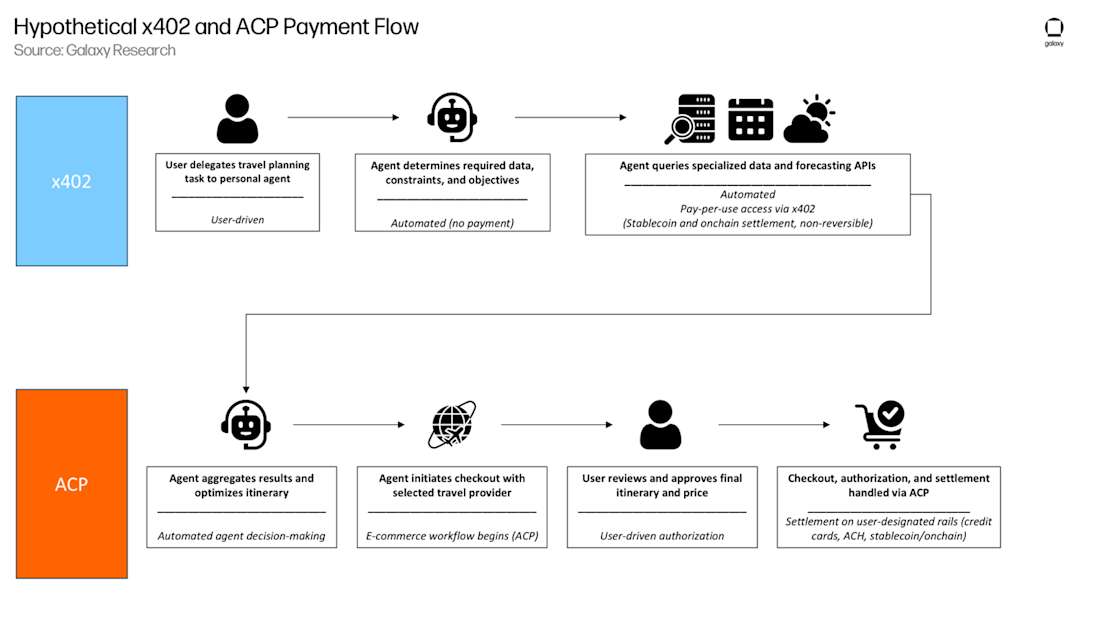
To visualize how these components interact, consider the flow of an x402 transaction where an agent discovers a service, negotiates payment, and receives data. The following image illustrates the hypothetical flow of x402 and AI agents in the AI economy, highlighting the interaction between the endpoint and the agent.
Recommended developer hardware
Running x402 endpoints, especially those processing high-frequency research data, demands reliable hardware. The following tools are essential for setting up a robust development and hosting environment.


As an Amazon Associate, we may earn from qualifying purchases.
Market analysis of agent commerce
The x402 ecosystem is rapidly maturing from a theoretical protocol into a functional payment layer for internet-native services. Backed by a coalition of payment networks, cloud platforms, and crypto-native infrastructure teams, x402 aims to solve the friction that currently blocks autonomous machine-to-machine commerce. The protocol enables AI agents and web services to autonomously pay for API access, data, and digital services without human intervention x402.org/ecosystem.
This shift represents a structural change in how digital value is exchanged. Traditional API monetization relies on static subscriptions or complex enterprise contracts that are ill-suited for the bursty, granular nature of AI agent requests. x402 introduces a micropayment standard that aligns cost directly with usage, allowing agents to purchase exactly what they need, when they need it. This model reduces overhead for providers and lowers barriers to entry for developers building agent-driven workflows.
| Feature | Traditional API Monetization | x402 Micropayment Model |
|---|---|---|
| Payment Structure | Monthly/Annual Subscriptions | Per-Request Micropayments |
| Agent Compatibility | Low (Requires Human Auth) | High (Autonomous Execution) |
| Cost Efficiency | High waste on unused capacity | Pay-only-for-what-you-use |
| Integration Complexity | High (Enterprise Sales Cycle) | Low (Code-Level Integration) |
The economic implications of this shift are significant. By removing the need for large upfront commitments, x402 allows smaller data providers and niche API services to monetize their assets effectively. This creates a more liquid market for digital information, where value is determined by real-time demand rather than fixed pricing tiers. As agent commerce scales, the ability to settle transactions instantly and atomically will become a competitive advantage for platforms that adopt this standard.
Technical Architecture for High-Stakes x402 Endpoints
Building x402 endpoints for premium research feeds requires a architecture that treats payment verification as a first-class citizen, not an afterthought. The protocol relies on the X-Api-Key header to carry cryptographic proofs of payment, allowing AI agents and web services to autonomously access data without manual intervention. This design shifts the burden of trust from the user to the protocol, ensuring that every request is backed by a verifiable transaction before any sensitive data is served.
Settlement and Blockchain Integration
The core of the x402 implementation involves validating the cryptographic signature attached to the request against the blockchain ledger. For high-stakes research, this validation must be fast and deterministic. The endpoint checks the X-Api-Key header, extracts the payment proof, and verifies it against the relevant smart contract or blockchain state. If the proof is valid, the service grants access; if not, it returns a 402 Payment Required status. This flow ensures that payment is settled before the API processes the request, eliminating the risk of non-payment for premium data.
Security and Data Protection
Security in x402 endpoints extends beyond payment verification. Since the protocol handles sensitive financial data, the implementation must protect against replay attacks and unauthorized access. This is achieved by using ephemeral keys and short-lived tokens that expire after a single use or a brief time window. Additionally, the endpoint should enforce strict rate limiting and input validation to prevent abuse. By combining cryptographic payment proofs with robust security practices, x402 endpoints can provide a secure and reliable infrastructure for premium research feeds.
Frequently asked questions about x402
How does x402 enable AI agent payments?
The x402 protocol allows AI agents to execute per-request stablecoin payments directly through HTTP headers. This removes the need for human intervention, allowing agents to scale programmatic workflows by paying for API calls, data queries, or research access automatically. By embedding payment logic into the standard HTTP request, x402 turns every API call into a potential transaction.
What are the typical costs for x402 endpoints?
x402 supports true micropayments, making it cost-effective for high-frequency data access. For example, a single research paper might cost $0.10, a premium news article $0.05, and a complex dataset query $0.25. These low-cost, per-use fees are ideal for premium research feeds where users only pay for the specific data they need.
Which wallets are compatible with x402?
x402 is designed to work with any wallet that supports stablecoin transactions and can sign HTTP headers. This includes popular self-custody wallets and programmable wallet interfaces used by AI agents. The protocol does not require a specific proprietary wallet, ensuring broad compatibility across the decentralized finance ecosystem.
Can x402 be used for non-financial data?
Yes. While often associated with financial data, x402 can secure any digital asset that requires access control. This includes premium news articles, specialized research datasets, and proprietary AI models. The protocol ensures that only paying users or agents can access the requested content, creating a reliable revenue stream for data providers.
No comments yet. Be the first to share your thoughts!