How x402 secures data access
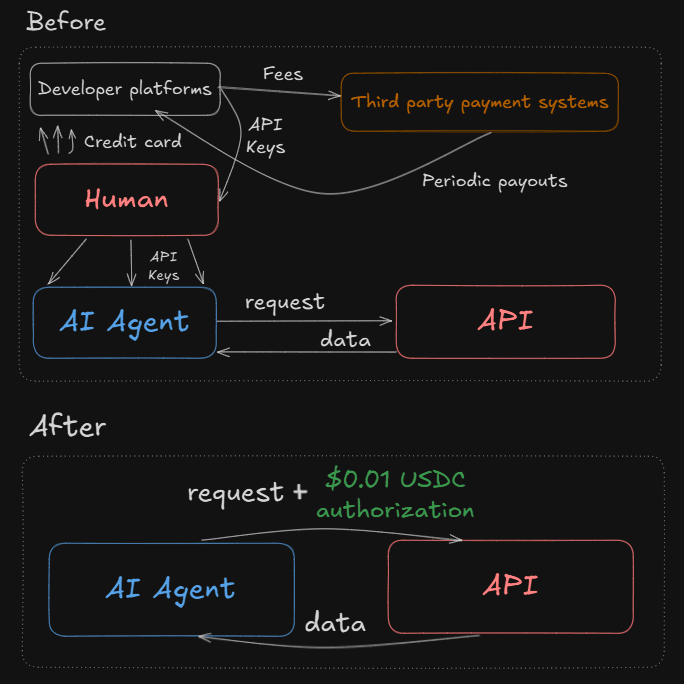
x402 is an open payment standard that handles micropayments at the protocol level, enabling instant USDC settlement for premium data feeds. Instead of relying on complex subscription gateways or API keys that can be shared or stolen, x402 integrates payment verification directly into the HTTP request lifecycle. This approach allows agents to pay for research data using stablecoins, establishing a trustless environment where access is granted only after payment is confirmed.
When you build x402 endpoints for premium research feeds, you are essentially turning your HTTP response into a receipt. The server checks for a valid payment token in the request headers. If the payment is valid, the server returns the requested data—whether it’s real-time market data, compliance reports, or specialized AI inference results. If not, it returns a 402 Payment Required status code, prompting the client to settle the debt.
This mechanism is particularly valuable for high-stakes financial data, where security and immediacy are paramount. By using x402, developers can create endpoints that are both secure and efficient, ensuring that only paying users access sensitive information. For more details on the technical implementation, refer to the x402 documentation.
The result is a streamlined workflow for both providers and consumers of premium data. Providers get paid instantly without the friction of traditional payment processors, while consumers gain access to real-time, high-quality research feeds with minimal integration overhead. This standard is reshaping how we think about digital access, making it more direct and transparent.
Set up the x402 facilitator
To build reliable x402 endpoints for premium research feeds, you need a bridge between your API and the blockchain. The Coinbase Developer Platform (CDP) Facilitator acts as that bridge. It handles the heavy lifting of payment discovery and verification, allowing your endpoints to accept USDC without managing private keys or complex smart contract interactions directly.
Think of the Facilitator as a trusted escrow agent. When an AI agent or client requests data, the Facilitator verifies that the payment has been made on-chain. Once confirmed, it grants access to your premium research data. This setup is essential for creating secure, automated payment-gated APIs.
Install the Facilitator SDK
Start by adding the CDP Facilitator SDK to your project. This library provides the necessary functions to interact with the x402 protocol. It simplifies the process of verifying payments and issuing tokens.
npm install @coinbase/facilitator-sdk
Configure Your Environment
Set up your environment variables with your Facilitator API key and secret. These credentials authenticate your requests to the CDP infrastructure. Ensure these values are stored securely and never exposed in your client-side code.
Implement Payment Verification
Integrate the Facilitator into your API routes. When a request comes in, use the SDK to verify the payment token. If the payment is valid, return the premium research data. If not, return an authentication error. This step ensures that only paying users access your content.
Test with USDC
Use a testnet environment to verify your x402 endpoints for premium research feeds. Send test USDC payments and confirm that the Facilitator correctly validates them. This testing phase is critical to ensure your endpoints work as expected before going live.


As an Amazon Associate, we may earn from qualifying purchases.
Monitor and Maintain
Once your endpoints are live, monitor the Facilitator logs for any failed verifications. Adjust your configuration as needed to handle edge cases. Regular maintenance ensures your premium research feeds remain accessible and secure for paying users.
Return HTTP 402 with Payment Instructions
The first step in building x402 endpoints for premium research feeds is teaching your server how to say "no"—but politely, and with a clear path forward. When an unauthenticated or unpaid request hits your endpoint, you must respond with an HTTP 402 Payment Required status code. This isn't just a rejection; it's a structured invitation to pay.
According to the x402 specification, the 402 status code carries specific headers that guide the client's next move. You aren't just blocking traffic; you're providing the metadata needed for an automated payment flow. This is what separates a standard paywall from a true x402 integration.
Configure the Response Headers
When you detect a missing or invalid micropayment, return a 402 status along with these critical headers:
X-HTTP-Status-Code: 402: Ensures compatibility with systems that tunnel 402 over 200.Payment-Required: true: Signals that payment is the barrier.Accept-CH: Sec-CH-Pay: Requests the client's payment capabilities.Payee: <your-destination>: Tells the client where to send the funds.
Structure the Payment Payload
The body of your 402 response should contain a JSON object describing the payment request. This includes the amount, currency (usually CSP for Cryptographic Service Payments), and the specific resource being protected.
{
  "amount": "100",
  "currency": "CSP",
  "description": "Access to premium research feed",
  "payee": "your-x402-destination"
}
This structured response allows x402-compatible clients to automatically pop up a payment dialog. Without these specific headers and payload structure, the client has no way to know how much to pay or where to send it, breaking the seamless flow you're aiming for. By sticking to the spec, you ensure that your premium research feeds are accessible to any x402-ready browser or agent.
Verify payment proof on subsequent requests
Once a user has satisfied the initial payment, your x402 endpoints for premium research feeds must seamlessly transition to authenticated access. The goal is to validate the payment proof embedded in the request header without forcing the user to pay again. This step ensures that only clients with a valid, verified transaction hash can retrieve high-value market data or compliance feeds.
When the client makes a subsequent request, they include the payment signature or transaction hash in a custom header (typically X-Payment-Proof). Your server acts as the verifier, checking this proof against the blockchain or the specified payment rail. For example, if you are using USDC on a supported network, you verify that the transaction exists and matches the expected amount.
const paymentProof = req.headers['x-payment-proof'];
const isValid = await verifyOnChain(paymentProof);

if (!isValid) {
  return res.status(402).json({ error: 'Invalid or expired payment proof' });
}

// Grant access to premium research data
return res.json(premiumData);
If the proof is invalid or expired, return a 402 Payment Required status immediately. This keeps the API secure and prevents unauthorized access to sensitive research. For detailed technical implementation of x402 headers and verification logic, refer to the x402.org specification or the Coinbase Docs on handling crypto payments.

Read the X-Payment-Proof header from the incoming request. This string contains the cryptographic signature or transaction ID that proves the user paid for the previous tier of access.
Pass the extracted proof to your verification service. If using a blockchain, check the transaction status. If using a fiat gateway, validate the webhook confirmation. Ensure the proof is recent and matches the required data tier.

If the proof is valid, proceed to serve the premium research feed. If invalid or expired, return a 402 Payment Required response, prompting the user to pay again or refresh their credentials.
Handle Payment Expiry and Refresh
When building x402 endpoints for premium research feeds, you are not just selling a one-time download; you are managing a subscription lifecycle. Unlike traditional credit card billing, where a failed payment might trigger a soft decline, crypto payments are atomic. Once a transaction is confirmed, it is final. This means your endpoint must explicitly handle the passage of time and the expiration of access tokens to prevent users from holding onto premium data indefinitely without paying again.
To manage this effectively, structure your payment logic around three distinct phases: initial expiry detection, refresh token generation, and graceful error handling. This ensures your API remains robust even when network conditions or user intent change.
Every time a client hits your endpoint, verify the validity of the attached payment proof. If the proof is expired or missing, immediately return an HTTP 402 status code. Do not serve partial data or cached results. Your response body should clearly indicate that the previous session has ended and provide instructions for the next payment cycle. This transparency is critical for maintaining trust in your premium research feed.
For recurring subscriptions, avoid forcing users to re-enter payment details for every single request. Implement a refresh token mechanism where a long-lived access token is exchanged for a short-lived session token upon successful payment. When the session token nears its expiration limit, your endpoint should return a specific error code (e.g., 402 with a refresh_required flag) that prompts the client to request a new session token. This reduces friction while ensuring regular payment verification.
Blockchain confirmations can take time. Your x402 endpoints for premium research feeds should implement a temporary grace period or a "pending" state. If a payment proof is submitted but the blockchain confirmation is still in progress, return a 202 Accepted status with a retry_after header. This prevents race conditions where a user is denied access simply because the network is slow, not because they haven't paid.
Finally, ensure your validation logic rejects expired proofs entirely. Do not accept "stale" payments for new requests. If a user tries to reuse a proof from last month, reject it with a clear 402 error. This enforces the economic model of your premium feed and ensures that only current, active subscribers have access to the latest research data.
Avoid these x402 endpoint mistakes
Building x402 endpoints for premium research feeds sounds straightforward until a client tries to bypass the payment layer. The x402 specification is still evolving, and the most common integration mistakes stem from treating payment validation as an afterthought rather than a core security boundary. If your endpoint trusts the client too much, your premium data becomes free content.
Skipping strict proof validation
The biggest mistake is accepting a payment proof without verifying its cryptographic signature and expiration. In x402, the client sends a payment proof in the header, but your server must independently verify that this proof was signed by a valid wallet and hasn't expired. Do not rely on the client to tell you the data is paid for. Always check the x-paypro header against the x402 specification requirements. If the signature is invalid or the token is stale, reject the request immediately. This prevents unauthorized access to your research data.
Ignoring error handling for failed transactions
When a payment fails, your endpoint should return a clear, structured error response that aligns with x402 standards. A generic 500 error or a vague "access denied" message frustrates users and makes debugging difficult. Instead, return a specific HTTP status code (like 402 Payment Required) with a body that explains why the proof was rejected. This helps developers integrate your endpoint correctly and reduces support tickets. Remember, your endpoint is part of a broader payment ecosystem, so clarity is key.
Hardcoding payment logic
Avoid hardcoding payment verification logic directly into your main business logic. This makes your code brittle and hard to maintain. Instead, create a middleware or utility function that handles all x402 proof validation. This separation of concerns ensures that your research feed logic remains clean and focused on delivering data, while the payment layer handles security. It also makes it easier to update your validation logic as the x402 spec evolves.

No comments yet. Be the first to share your thoughts!