Why x402 fits agent commerce
Traditional API billing relies on monthly invoices, credit limits, and manual provisioning. This model creates friction for AI agents that operate at machine speed. An agent needs to query a premium financial feed, pay, and receive data in milliseconds. It cannot wait for a finance team to approve a purchase order.
x402 solves this by embedding payment directly into the HTTP protocol. When an agent sends a request to an endpoint, the server returns a 402 Payment Required status code along with a payment instruction. The agent pays via crypto, receives a signed receipt, and retries the request to access the data. This creates a trustless, instant settlement layer for high-value information.
x402 is an HTTP extension that requires payment before data delivery, making it ideal for autonomous agents that need instant, trustless access to premium data.
This architecture shifts the burden from administrative overhead to cryptographic verification. For finance and AI developers, it means premium research feeds can be sold in micro-amounts without requiring user accounts or complex billing integrations. The endpoint becomes a self-contained commerce node.
As noted in AWS and Antier analyses of the protocol, this enables enterprises to grant AI agents instant access to premium endpoints. The agent handles the transaction logic internally, treating data access like any other API call, just with a mandatory payment step. This is the foundation for true agentic commerce in financial services.
Core infrastructure components
x402 Endpoints for Premium Research Feeds works best as a clear sequence: define the constraint, compare the realistic options, test the tradeoff, and choose the path with the fewest hidden costs. That order keeps the advice usable instead of decorative.
After each step, pause long enough to check whether the recommendation still fits the reader's actual situation. If it depends on perfect timing, unusual access, or a best-case budget, include a simpler fallback.
The simplest way to use this section is to write down the real constraint first, compare each option against it, and choose the path that still works outside ideal conditions.
Top research feed use cases
The real value of x402 isn't just in paying for data; it's in how that data flows into your applications. By moving from static API keys to micropayment-gated endpoints, you unlock use cases that were previously too expensive or technically complex to scale.
Here are the most practical applications for developers building financial or AI-driven tools.
Real-time market data
High-frequency trading bots and retail analytics dashboards live and die by latency and cost. Traditional institutional feeds charge thousands per month, while free tiers are often delayed or rate-limited. With x402, a Python script can request a live tick of Bitcoin or Ethereum, pay a fraction of a cent via a crypto transaction, and receive the data in the same HTTP response.
This model is perfect for event-driven architectures where you only pay when you actually trigger a query. For example, a bot checking the current price of BTC on Binance can use a PriceWidget-style logic to fetch the latest quote only when a specific condition is met, keeping operational costs near zero until execution.
AI inference endpoints
Large Language Models (LLMs) are expensive to run at scale. Sahara AI and other providers are beginning to expose inference endpoints that accept x402 payments. This allows an application to send a prompt, pay for the compute, and get the generated text back without managing a separate billing account or credit card on file.
It turns AI compute into a utility. If your app needs to summarize a news article or analyze a sentiment trend, it can call the endpoint, pay the small fee, and move on. This is particularly useful for on-demand features that don't run continuously.
Aggregated yield and DeFi analytics
DeFi yields change by the second. Aggregating data across dozens of protocols—Aave, Compound, Uniswap—requires many separate API calls. An x402 endpoint can bundle this data, returning a single JSON object with the current APYs across major pools.
As noted in industry discussions, users can pay a small fee to query this aggregated data before deciding where to deploy capital. This reduces the overhead of managing multiple API keys and simplifies the logic for yield-hunting algorithms.
Comparison: Traditional vs. x402 Access
The shift from subscription-based API keys to x402 micropayments changes how you budget for data. Instead of a fixed monthly cost for access you might not fully use, you pay per query.
Implementation steps for sellers
Getting your research feed ready for x402 payments doesn't require a complete rewrite of your backend. The goal is to intercept the request, check for a valid payment, and then release the data. We will follow the official quickstart guide from Coinbase, which outlines the most straightforward path for API sellers.

Before writing code, you need a destination for the payments. Create a Coinbase Commerce account or use an existing CDP-compatible wallet. This wallet address will be embedded in your API responses so buyers (or their AI agents) know where to send the funds.

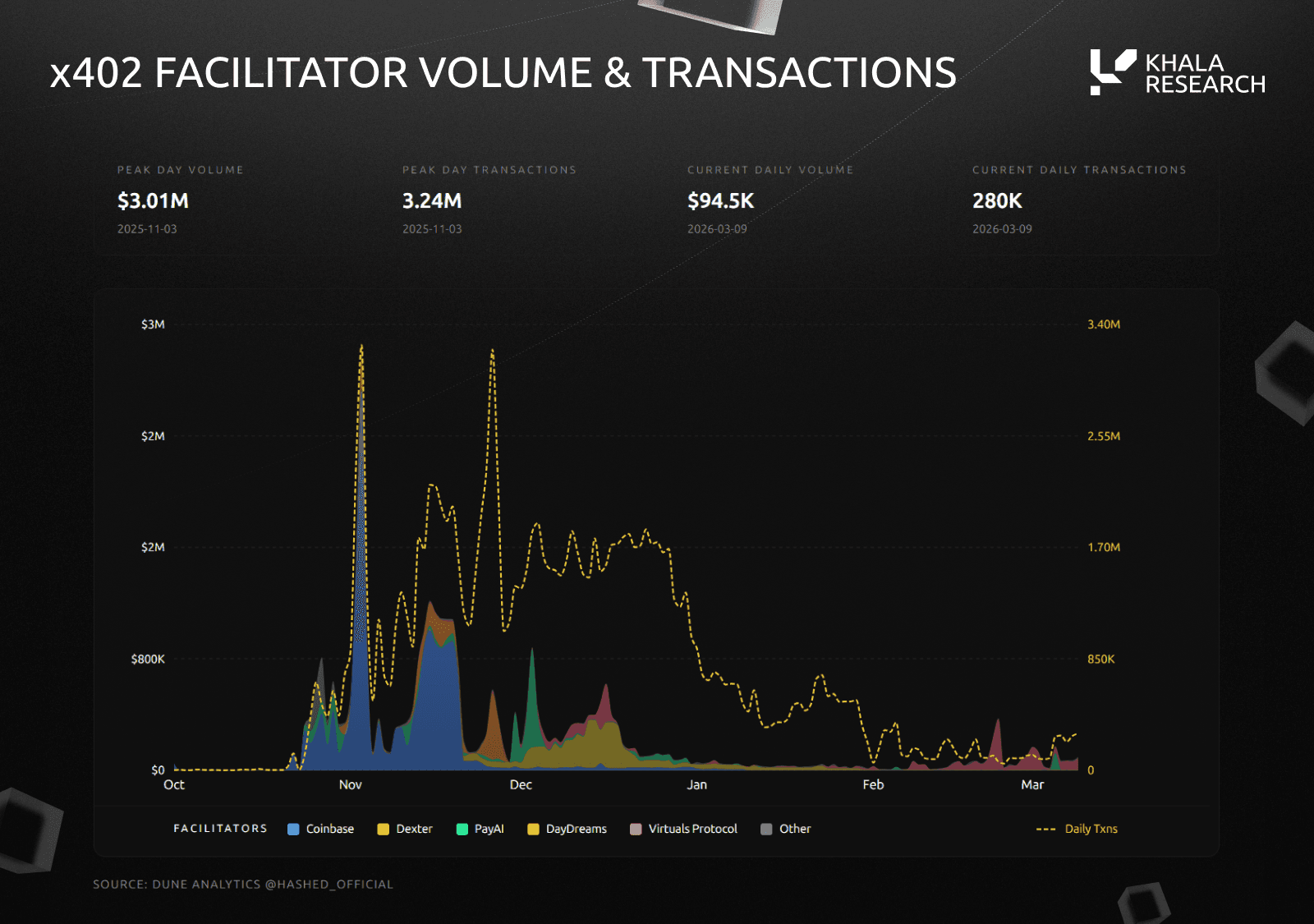
x402 relies on a facilitator service to handle the complex blockchain interactions. You don't need to run a node. Instead, integrate with a provider like Coinbase's facilitator. This service validates the transaction on-chain and notifies your API when a payment is confirmed. Configure your API to listen for these webhook events.
Update your endpoint logic to check for the x-pay header. When a request arrives, your facilitator should have already verified the payment. If the payment is valid, return your premium research data. If not, return a 402 Payment Required status with instructions on how to pay. This keeps the integration lightweight and focused.
Never test directly on mainnet. Use the Coinbase sandbox environment to simulate payments. This allows you to verify that your API correctly rejects unpaid requests and accepts paid ones without risking real funds. Once your flow is stable, switch to production credentials.
For a visual breakdown of the payment flow, refer to the official Alchemy diagram which illustrates how the facilitator bridges the gap between your API and the blockchain. This clarity helps developers avoid common pitfalls during integration.
Always refer to the Coinbase x402 Quickstart for Sellers for the most up-to-date code snippets and configuration details. The x402 protocol is still evolving, and official docs are the single source of truth.
Setting prices for premium research feeds
With x402, you can charge for data access with unprecedented granularity. Instead of forcing users into rigid monthly subscriptions, you can price individual API calls or small data batches. This micropayment model aligns perfectly with how AI agents and developers consume information—they only pay for what they actually use.
For finance and AI developers, this means your premium research feeds become a utility rather than a gatekept product. You can set a flat fee per query or tier your pricing based on data depth. The low transaction costs of x402 make micro-transactions viable, turning high-frequency data requests into a sustainable revenue stream without the friction of traditional billing.
To contextualize the cost, here is the current live price of USDC, the standard stablecoin for these transactions:
No comments yet. Be the first to share your thoughts!